

Should I Take the CELTA Full-Time or Part-Time?
| Teaching House Nomads Blog
Choosing between a full-time and part-time CELTA is not really about deciding which course is better. Both routes lead to the same Cambridge CELTA qualification. The real question is: which study format fits your work, commitments, learning style and career plans?
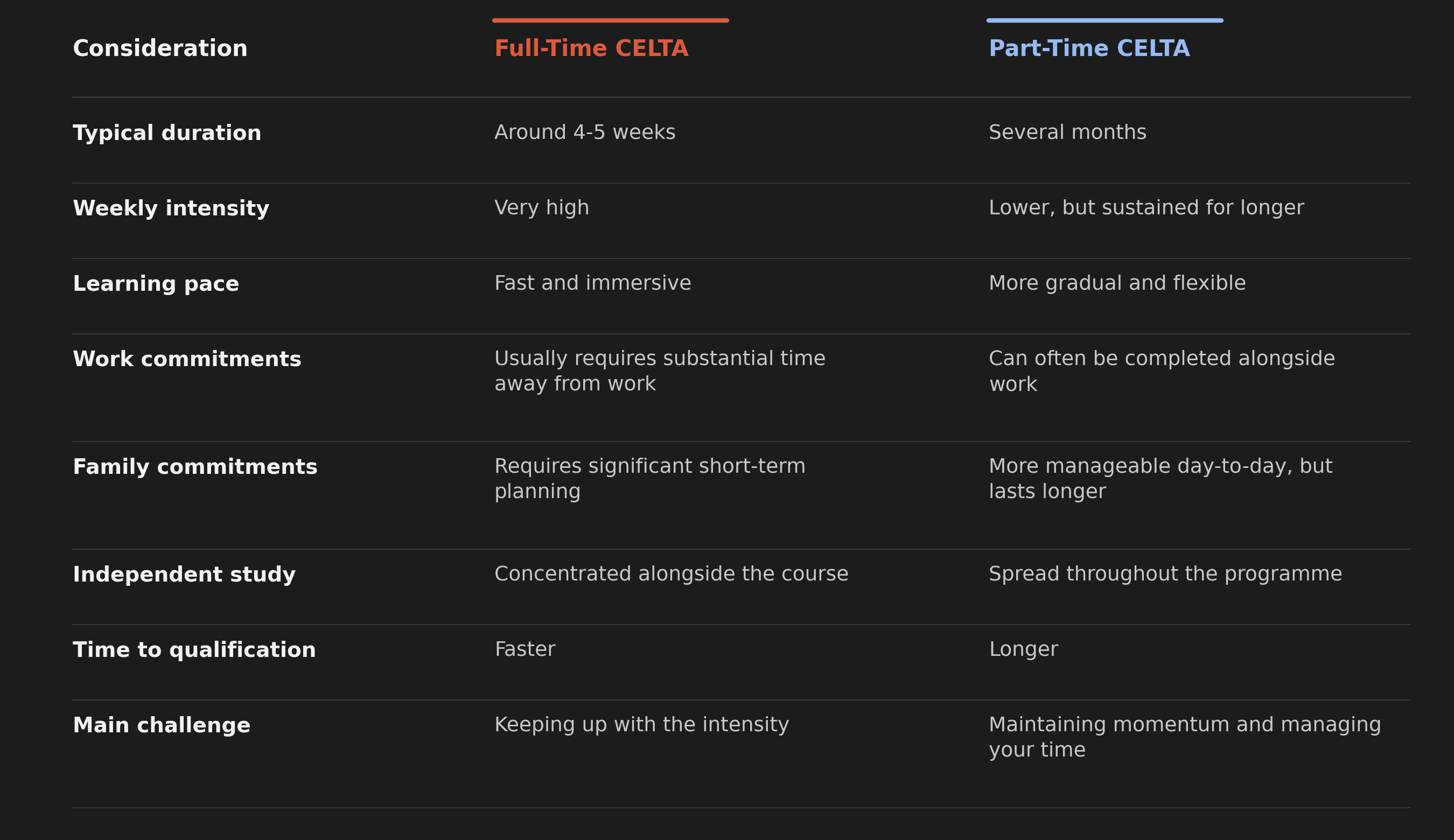
A full-time CELTA concentrates an intensive programme into a short period, usually around four to five weeks. A part-time CELTA spreads the course over a longer period, giving you more flexibility to continue working or manage other commitments alongside your studies. Neither option is automatically easier. A full-time course can be demanding because of the pace and intensity. A part-time course gives you more time, but requires you to maintain your focus and keep up with regular coursework over a much longer period.
So, which one is right for you?
Full-Time vs Part-Time CELTA: At a Glance
What Is the Same on a Full-Time and Part-Time CELTA?
Before comparing the two formats, it is worth understanding what does not change. Cambridge CELTA courses can be delivered on a full-time or part-time basis, but both must meet Cambridge's course requirements. Candidates complete at least 120 hours of course contact, including assessed teaching practice, alongside additional time for lesson preparation, reading, research, assignments and other course-related work.
Candidates also complete four written assignments, while assessment takes place continuously throughout the course rather than through a final examination. Your teaching practice, lesson planning, understanding of learners, reflection and overall development are assessed against the same Cambridge standards regardless of whether you study full-time or part-time. In other words, there is no separate "full-time CELTA" qualification and "part-time CELTA" qualification.
You become CELTA qualified. The difference is how you get there.
1. How Quickly Do You Need to Become CELTA Qualified?
Your career timeline may be the biggest factor in your decision. Perhaps you want to start teaching abroad, apply for an English teaching position, change careers or begin teaching at a particular time of year. If you have a firm deadline, start by working backwards from the date when you need to be qualified.
A full-time CELTA can allow you to complete the course in around a month, making it suitable for candidates who want to qualify within a relatively short period.
A part-time CELTA, by comparison, may take several months depending on the provider and timetable.
There is another timing consideration that is easy to overlook: finishing your course is not necessarily the same as receiving your physical certificate. At the end of your CELTA, you will normally receive documentation confirming your result, while Cambridge certificates are generally issued after the course has been completed. If you have a job offer or employer deadline, check exactly which documentation they require and whether a candidate report or equivalent confirmation will be accepted while you wait for your certificate.
Ask yourself:
When do I actually need to be qualified?
If you have a specific deadline, a full-time course may make it easier to work towards it. If you have plenty of time, you have greater freedom to choose based on your lifestyle and preferred way of learning.
2. Can You Clear Your Diary for a Full-Time CELTA?
A common misconception is that a full-time CELTA simply means attending classes during the day. In reality, CELTA involves more than classroom or live training hours. Alongside tutor-led sessions and teaching practice, you will need time for lesson planning, reading, language analysis, written assignments, preparation and reflection. This means a full-time CELTA should be treated as a serious short-term commitment.
Before enrolling, consider whether you can:
- Take sufficient leave from work
- Arrange childcare or other caring responsibilities
- Reduce social and household commitments temporarily
- Protect your evenings for preparation and assignments
- Create a quiet space for studying
- Avoid major work deadlines during the course
This does not mean you need to put your entire life on hold. It does mean that you should plan for the workload rather than assuming you will find spare time when you need it. For some candidates, taking several weeks away from work is easier than balancing study with a full-time job for several months.
3. Do You Need to Continue Working While You Study?
This is one of the biggest practical differences between full-time and part-time CELTA.
A full-time course can work particularly well if you are:
- Between jobs
- Taking annual leave
- On a career break
- Changing careers
- Able to dedicate several weeks entirely to your training
If you are working full-time, however, taking a month away from work may not be realistic. A part-time CELTA can make it possible to continue working while you study. However, part-time does not mean part-effort. Think about your current working pattern. A predictable 9-to-5 schedule is generally easier to combine with CELTA than a job involving frequent overtime, business travel, evening meetings or unpredictable shifts. You should also check the exact timetable before enrolling. Teaching practice, tutor sessions and other elements of the course may take place at specific times, so you cannot assume that every part of the course can be completed whenever you are free.
4. What Does "Part-Time" Actually Mean?
Not all part-time CELTA courses are structured in the same way.
Depending on the provider, a part-time programme may involve:
- Weekday evening sessions
- Weekend training
- A combination of evenings and weekends
- Fixed live sessions alongside independent study
- Online or blended delivery
This means you should look beyond the words "part-time" or "online" when comparing courses. For example, a Saturday course may protect your weekday evenings, but you will still need to find time during the week for lesson preparation and assignments. An evening course may leave your weekends free, but attending training after a full working day can be tiring.
The question is not simply:
"When are the classes?"
It is:
"When will I realistically have the energy and time to complete everything else?"
If you are considering an online CELTA, check the timetable carefully, particularly if you live in a different time zone from the training centre.
5. How Do You Prefer to Learn?
Your learning style can also influence the decision.
If you like immersion and momentum
Some people learn best when they can focus intensely on one subject. With a full-time CELTA, the connection between theory, teaching practice and feedback can happen very quickly. You may learn something in a training session, apply it in your teaching, receive feedback and then use that feedback in your next lesson. This creates a strong sense of momentum. The trade-off is that there is less time to pause. You may have to make decisions, teach and adapt before you feel completely comfortable.
If you prefer time to reflect
Other learners prefer to process new information gradually. A part-time CELTA gives you more time between sessions to revisit your notes, read around a topic, think about feedback and prepare for your next teaching practice. That extra space can be useful when you are learning unfamiliar concepts such as language analysis, lesson staging or teaching methodology. However, flexibility only helps if you use it well. A part-time course still requires consistent study. Leaving everything until the last minute can quickly turn a flexible timetable into a stressful one.
6. Are You a Perfectionist or a Procrastinator?
This is an underrated part of the decision. If you tend to overthink and over-prepare, having more time is not necessarily an advantage. A part-time course may give you several days to keep adjusting a lesson plan, redesigning materials or rewriting an assignment. Before you know it, you have spent far longer on the task than necessary. A full-time course, by contrast, forces you to make decisions and move on. On the other hand, if you tend to procrastinate, the structure of a full-time course may help. With teaching practice, feedback and training happening close together, there is less opportunity to put work off for another week. A part-time course can work perfectly well for a procrastinator too, but you need to be comfortable creating your own study routine and meeting regular deadlines.
Ask yourself honestly:
Which is more likely to cause problems for me — having too little time or having too much time?
7. How Comfortable Are You With Independent Study?
The amount and type of independent study can vary between CELTA providers and course formats. Some programmes concentrate more tutor-led training into live sessions, while others use asynchronous learning to provide additional flexibility. At Teaching House, for example, the full-time and part-time formats are structured differently, with the part-time route incorporating fixed live sessions alongside additional asynchronous theory and methodology. This can be useful if you need to fit CELTA around work or other commitments, but it also means you need to be comfortable managing your own study time.
Before enrolling, ask the provider:
- How many hours are live and tutor-led?
- How much of the course is asynchronous?
- When does teaching practice take place?
- How much independent study should I expect each week?
- How are assignments scheduled?
- What happens if I cannot attend a live session?
These questions will give you a much clearer picture of the course than simply asking whether it is "full-time" or "part-time".
8. What Is Your Previous Teaching Experience?
You do not need to be an experienced teacher to take CELTA. However, your previous experience may affect how you experience the course. If you have taught before, you may already be comfortable managing a classroom or speaking in front of learners. At the same time, CELTA may introduce you to approaches and terminology that are completely new. If you have never taught before, you may initially find everything new — from lesson planning and classroom management to analysing language and responding to learner needs. Neither background automatically makes one course format more suitable. Some new teachers enjoy the intensity of a full-time programme because they can immerse themselves completely in their training. Others benefit from having more time to process unfamiliar concepts through a part-time course.
Your CELTA interview is a good opportunity to discuss your previous experience, career plans and preferred study format with the course provider.
9. How Do You Handle Feedback and Pressure?
Feedback is a central part of CELTA. During teaching practice, you will plan a lesson, teach, receive feedback, reflect on your performance and apply what you have learned to future lessons. On a full-time course, this cycle can happen very quickly. That can be rewarding because you can see your development from one lesson to the next. However, the pace can also feel intense, particularly after a lesson that did not go as planned. With a part-time course, you may have more time between teaching sessions to process feedback and consider what you want to change.
Think about how you prefer to develop:
Do you like to try something again quickly while the experience is fresh, or do you prefer time to reflect before your next attempt?
Either way, being open to feedback is essential.
CELTA is designed as a teacher-training qualification. You are not expected to be a fully developed teacher on day one. What matters is your ability to learn, reflect and demonstrate development throughout the course.
So, Should You Take the CELTA Full-Time or Part-Time?
There is no universal answer.
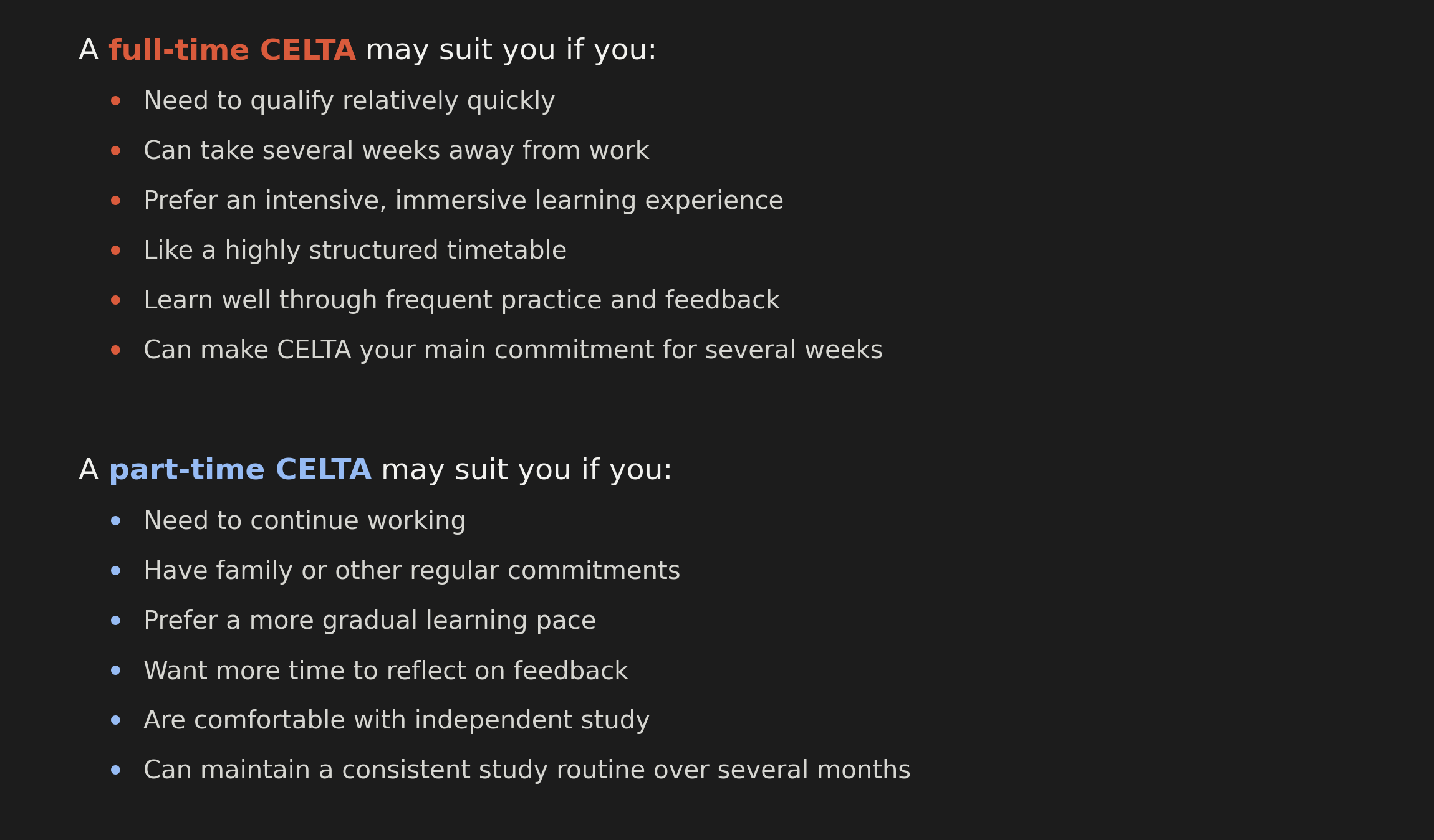
Choose based on which format you can realistically commit to.
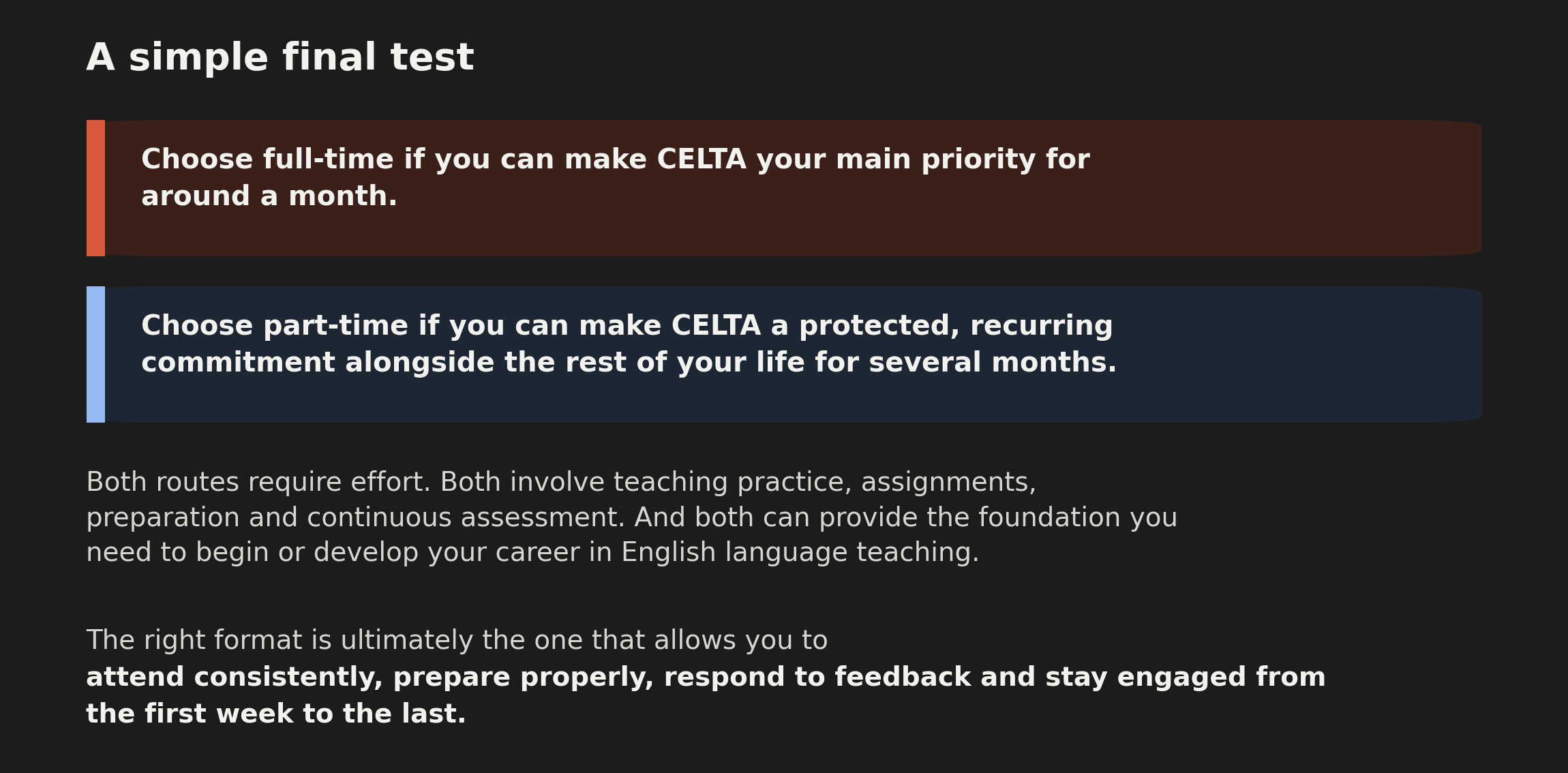
A simple final test
Ready to Start Your CELTA?
If you are still deciding between full-time and part-time CELTA, the next step is to look closely at the timetable, workload and delivery format of the course you are considering.
Teaching House offers CELTA courses designed for different schedules and learning needs. Explore the available course options to find a format that works with your career plans and commitments.


Subscribe to the Nomad's Blog